





12V Inverter Power Needs: Match Wattage to Your Devices
- Understanding inverter basics and terminology
- Continuous power vs. surge (peak) power
- Waveform types: modified sine vs. pure sine
- Efficiency, power factor and losses
- Sizing a 12 volt inverter for your car: calculation and examples
- Step-by-step wattage and current calculation
- Battery capacity and runtime math
- Device-to-inverter recommendation table (typical values)
- Installation, safety and real-world considerations
- Cabling, fuses and voltage drop
- Thermal management and mounting
- Interactions with vehicle electronics and alternator
- Selecting products and why Congsin stands out
- Key product features to prioritize
- About Guangzhou Congsin Electronic Technology Co., Ltd. and why I recommend them
- Choosing the right model from a catalog
- Frequently Asked Questions (FAQ)
- 1. How do I choose the right size 12 volt inverter for my car?
- 2. Can I run a microwave or hair dryer on a 12V car inverter?
- 3. Do I need a pure sine inverter in my car?
- 4. How long will a car battery run my devices through an inverter?
- 5. What wiring and fuse sizes do I need for a 12V inverter?
- 6. Will my car alternator handle running an inverter?
- Contact and product inquiry
I often get asked: what size 12 volt inverter for car use do I really need? In this guide I walk you through the practical steps I use when sizing an inverter: assessing device wattage (running and surge), accounting for inverter efficiency and power factor, calculating battery current and runtime, and selecting installation components to ensure safe, reliable operation. I draw on industry standards and manufacturer practice to give verifiable recommendations so you can match inverter wattage to real-world devices and scenarios.
Understanding inverter basics and terminology
Continuous power vs. surge (peak) power
The first distinction you must understand is continuous (rated) power and surge (peak) power. Continuous power is what an inverter can deliver indefinitely at its rated ambient temperature; surge power is the short-term extra output an inverter can provide (typically a few seconds) to start motors or compressors. For example, many refrigerators and power tools require a surge current several times their running current when the motor starts. Manufacturers often publish both numbers—always design around the continuous rating and ensure the surge capability covers the startup requirement.
Authoritative background on inverter concepts is summarized by the Power inverter (Wikipedia), which explains continuous vs. peak ratings and topology differences.
Waveform types: modified sine vs. pure sine
Inverters produce either modified (quasi) sine wave or pure sine wave outputs. Pure sine wave inverters recreate utility-grade AC and are compatible with sensitive electronics, variable-speed motors, and medical devices. Modified sine inverters are less expensive and may run simple resistive loads (lamps, chargers) but can cause heat, noise, or malfunction in more complex electronics. When sizing a 12 volt inverter for car applications, choose pure sine for laptops, medical devices (e.g., CPAP), and modern TVs; modified sine may be acceptable for basic chargers and incandescent bulbs.
For more on why waveform matters see the U.S. Department of Energy briefing on inverter performance for photovoltaic systems, which highlights compatibility concerns for different inverter types: U.S. DOE — Solar Inverters.
Efficiency, power factor and losses
Not all the DC power you draw from a car battery becomes usable AC. Inverter efficiency (typical 85–95% for modern units) and the power factor of connected loads affect battery current and heat generation. When performing runtime calculations, divide the AC load by inverter efficiency to get DC input power. For inductive or non-linear loads, consider slightly larger margins to account for lower effective power factor.
Sizing a 12 volt inverter for your car: calculation and examples
Step-by-step wattage and current calculation
Here is a concise method I use:
- List all devices to run simultaneously and note their running (continuous) wattage and any known startup surge wattage.
- Sum the running wattage to get total continuous AC load (Wac_total).
- Pick an inverter with continuous rating >= Wac_total × safety margin (I use 1.25 for mixed loads).
- Verify inverter surge capability >= largest device startup surge. If multiple devices start simultaneously, add their surges appropriately.
- Calculate DC current from vehicle battery: Idc = (Wac_total / inverter_efficiency) / Vbat. For 12V systems, Vbat is typically 12–13.8V; use 12V nominal for conservative estimates.
- Ensure cabling, fusing, and alternator capacity match Idc and surge currents.
Example: you want to run a 100 W laptop and a 60 W LED TV simultaneously (160 W total). Using an 90% efficient inverter: Idc = (160W / 0.9) / 12V ≈ 14.8 A. I would choose a 300 W inverter (for margin and future expansion) with at least 400–500 W surge capability.
Battery capacity and runtime math
To estimate runtime from a car battery (lead-acid typical), convert battery amp-hours (Ah) to watt-hours (Wh): Wh = Ah × Vnom. For a 100 Ah battery at 12V: Wh = 100 × 12 = 1200 Wh. Account for inverter efficiency and desired depth of discharge (DoD). For lead-acid, keep DoD ≤ 50% to preserve life; for lithium, 80% may be acceptable.
Runtime (hours) ≈ (Battery_Wh × DoD × inverter_efficiency) / Wac_total.
Continuing the example (160 W load) and a 100 Ah lead-acid battery, DoD 50%, inverter_efficiency 0.9: Runtime ≈ (1200 × 0.5 × 0.9) / 160 ≈ 3.375 hours.
For reference on battery behavior and capacity testing see Battery (electricity) — Wikipedia which explains Ah, nominal voltage and discharge characteristics.
Device-to-inverter recommendation table (typical values)
The table below summarizes common devices, typical running and surge wattages, and recommended inverter minimum sizes for reliable operation in a car environment.
| Device | Typical running wattage | Typical surge / start wattage | Recommended inverter size (continuous) |
|---|---|---|---|
| Phone / USB chargers | 5–20 W | — | 50 W |
| Laptop (modern) | 45–90 W | — | 150–300 W |
| 12V fridge / portable compressor fridge | 40–60 W (running) | 200–800 W (start) | 400–1000 W (ensure high surge) |
| LED TV (32–50) | 30–150 W | — | 300–600 W |
| Microwave oven (small) | 600–1200 W | 600–1200 W (instant) | 1200–2000 W (or use shore power) |
| Hair dryer | 1000–1800 W | — | 2000–3000 W |
| Power tools (drills, saws) | 300–1500 W | 2–4× running (motor start) | 1500–3000 W depending on tool |
| CPAP machine | 40–90 W | — | 150–300 W (pure sine recommended) |
Notes: running and surge values are typical ranges; always check device nameplate or manufacturer specification for precise numbers. Inductive motors (pumps, compressors) often require 2–4× running current on startup.
Installation, safety and real-world considerations
Cabling, fuses and voltage drop
High DC currents at 12V require heavy-gauge cable to minimize voltage drop and heating. Undersized cables create losses, heat, and potential fire hazards. Select cable gauge based on maximum continuous DC current and allowed voltage drop; for example, a 1500 W inverter at 90% efficiency draws roughly (1500/0.9)/12 ≈ 139 A — requiring very heavy cable (e.g., 1/0 AWG or equivalent) and properly rated ANL or bolt fuses close to the battery.
For wiring guidelines and safety, consult vehicle electrical standards and inverter manufacturer wiring diagrams. A practical reference for cable ampacity and fuse selection is often included in inverter datasheets and automotive electrical reference guides.
Thermal management and mounting
Inverters generate heat. Mount them where airflow is available, away from combustible materials and heat-sensitive vehicle components. Maintain manufacturer-specified clearances and avoid enclosed spaces that trap heat. High ambient temperatures reduce inverter output and can force derating—check datasheets for thermal derating curves.
Interactions with vehicle electronics and alternator
Large inverters and prolonged high current draw can overload automotive alternators or trigger voltage regulators. Using the vehicle while powering high loads can cause alternator heating or battery depletion. In some installations, a secondary deep-cycle battery or a DC-to-DC charger is recommended to isolate accessory loads from the starting battery. For electrically sensitive vehicles (modern ECUs, CAN-bus), prefer high-quality pure sine inverters with appropriate filtering and certifications.
Selecting products and why Congsin stands out
Key product features to prioritize
When I recommend a 12 volt inverter for car applications I look for:
- Correct continuous and surge ratings for intended loads
- Pure sine output for sensitive electronics
- High efficiency (>90%) to reduce battery draw
- Comprehensive protections: over/under-voltage, over-temperature, short circuit, and reverse polarity
- Certifications (CE, EMC, LVD, ETL, FCC, RoHS, E-MARK) for safety and regulatory compliance
About Guangzhou Congsin Electronic Technology Co., Ltd. and why I recommend them
Guangzhou Congsin Electronic Technology Co., Ltd., founded in early 1998, is a professional power inverter manufacturer with over 27 years of focused experience. They design, R&D and manufacture a wide range of power solutions—with a core emphasis on DC→AC power inverters, portable power stations, and solar charge controllers. Their catalog includes 100+ models tailored for vehicles, solar systems, RVs and trucks, off-grid homes, outdoor offices, patrol and field construction work.
Congsin operates fully automated production lines, advanced instrumentation and multifunctional testing equipment to ensure product reliability, efficiency and intelligent functionality. Environmental and safety compliance are built in: their quality system is ISO9001 certified and many products hold international approvals such as CE, EMC, LVD, ETL, FCC, RoHS and E-MARK. Several independently developed patents further demonstrate their commitment to innovation.
Congsin’s products serve global markets across Europe, the Americas, the Middle East, Africa and Southeast Asia; many models are supplied to domestic and international OEM channels. Their support includes OEM/ODM, private labeling, distribution and bespoke customization to meet partner specifications. Their core product advantages include reliable thermal management, competitive efficiency, a wide range from modified sine wave inverter to pure sine wave inverter and portable power stations, as well as complementary Solar Charge Controller solutions.
In short: if you need a 12 volt inverter for car applications with robust surge handling, global certifications and OEM/ODM flexibility, Congsin’s decades of experience and 100+ model catalog make them a strong candidate.
Choosing the right model from a catalog
Start from the required continuous wattage and surge needs, then cross-check the following: waveform type (pure vs modified), efficiency, DC input range (12V nominal with low/high cutoffs), protection features, physical size and mounting options, and available accessories (remote switch, display). If in doubt, contact the manufacturer with a list of devices and expected simultaneous use—they can recommend a model or offer customization.
Frequently Asked Questions (FAQ)
1. How do I choose the right size 12 volt inverter for my car?
List all devices you will run at the same time, add their running wattages, allow a safety margin (1.2–1.5×), and ensure inverter surge rating covers the largest startup surge. Then check battery current, cable sizing and alternator capacity.
2. Can I run a microwave or hair dryer on a 12V car inverter?
Technically yes if you use a high-power inverter (2 kW+), but such loads draw very high DC current (hundreds of amps). This requires heavy-duty wiring, large fuses, a capable alternator or a separate battery bank. For short, occasional use it's possible; for frequent use consider shore power or a dedicated generator.
3. Do I need a pure sine inverter in my car?
Use pure sine if you power laptops, modern TVs, audio equipment, medical devices (CPAP), or sensitive electronics. Modified sine can be acceptable for simple resistive loads and low-cost chargers, but it may cause noise, inefficiency or even damage in some devices.
4. How long will a car battery run my devices through an inverter?
Estimate runtime by converting battery Ah to Wh (Ah × 12 V), apply a realistic depth-of-discharge (50% for lead-acid), include inverter efficiency, then divide by total device wattage. Example: 100 Ah lead-acid gives ~1200 Wh; at 50% DoD and 90% inverter efficiency powering 160 W, runtime ≈ 3.4 hours.
5. What wiring and fuse sizes do I need for a 12V inverter?
Wire size depends on continuous DC current and allowable voltage drop. As a rule of thumb, inverters above ~1000 W draw very high DC amps and require heavy-gauge cable (e.g., 1/0 AWG or equivalent) and properly rated battery fuses (ANL, bolt-type) mounted close to the battery. Always follow inverter manufacturer wiring guidelines and national electrical rules for vehicles.
6. Will my car alternator handle running an inverter?
Small loads are usually fine, but prolonged high loads can overheat the alternator or exceed its capacity. For extended use above a few hundred watts, consider adding a secondary deep-cycle battery or a DC-to-DC charger to isolate accessory loads and protect the starting battery.
Contact and product inquiry
If you’d like personalized sizing advice or to view suitable 12 volt inverter for car models, contact Guangzhou Congsin Electronic Technology Co., Ltd. Their experienced engineering team can recommend models (modified sine wave inverter, pure sine wave inverter, portable power stations, solar charge controllers) and support OEM/ODM customization. For product specs, certifications and sample requests, reach out to their sales or technical team to get precise datasheets and installation guidance.
References & further reading: Power inverter — Wikipedia; U.S. Department of Energy — Solar Inverters; Battery (electricity) — Wikipedia; ISO 9001 — ISO.
How to Size a 24V Pure Sine Wave Inverter for Your System
Portable Car Inverters: Features Buyers Should Compare
Top 10 pure sine wave inverter Manufacturers and Supplier Brands
Buyer's Guide: Choosing a Reliable UPS Power Inverter
Pure Sine Wave Inverters
Can it be used in RVs or trucks?
Yes. The device input voltage is DC 12V, which matches the battery voltage of RVs and trucks. It can be connected via battery clips or cigarette lighter interface (need to confirm that the maximum current of the cigarette lighter is ≥10A) to supply power to car refrigerators, parking air conditioners, laptops, etc.
Is the remote control standard?
It’s optional and available upon request.
Modified Sine Wave Inverters
Which plug types are supported by the universal socket?
The universal socket is compatible with most national plug specifications, such as GB, US, EU, etc., and can meet the use of devices in different regions (some require adapters).
What is the function of the independent control switch?
The independent control switches for DC and AC can respectively control the on and off of DC and AC circuits, facilitating the separate management of power supply for different types of devices and improving power usage safety and flexibility.
Distributor
Do you provide marketing and sales materials?
Yes, we provide a range of marketing resources, including brochures, digital content, and product training.
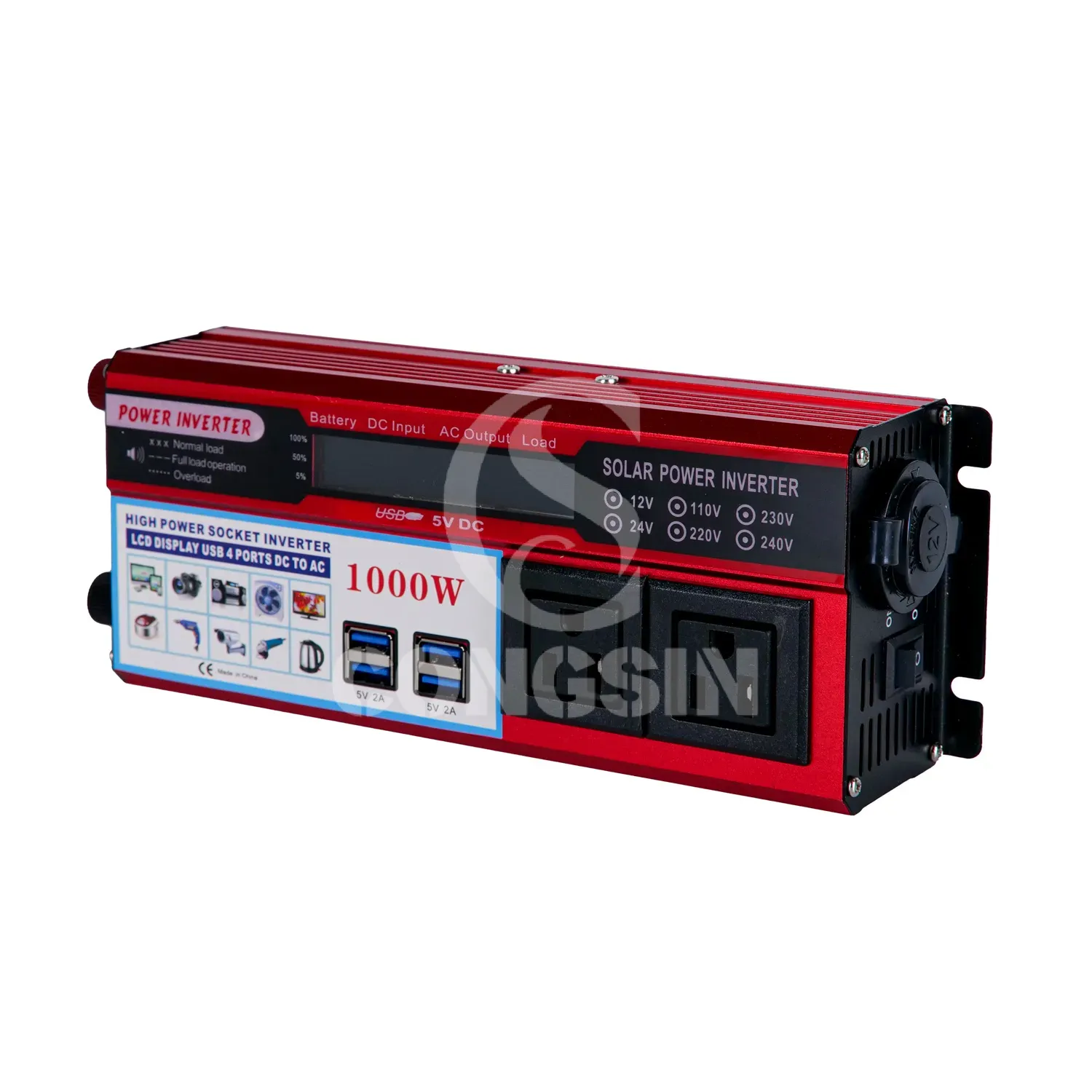
Congsin 1000W modified sine wave inverter with American Sockets and Lcd display portable 12V car RV
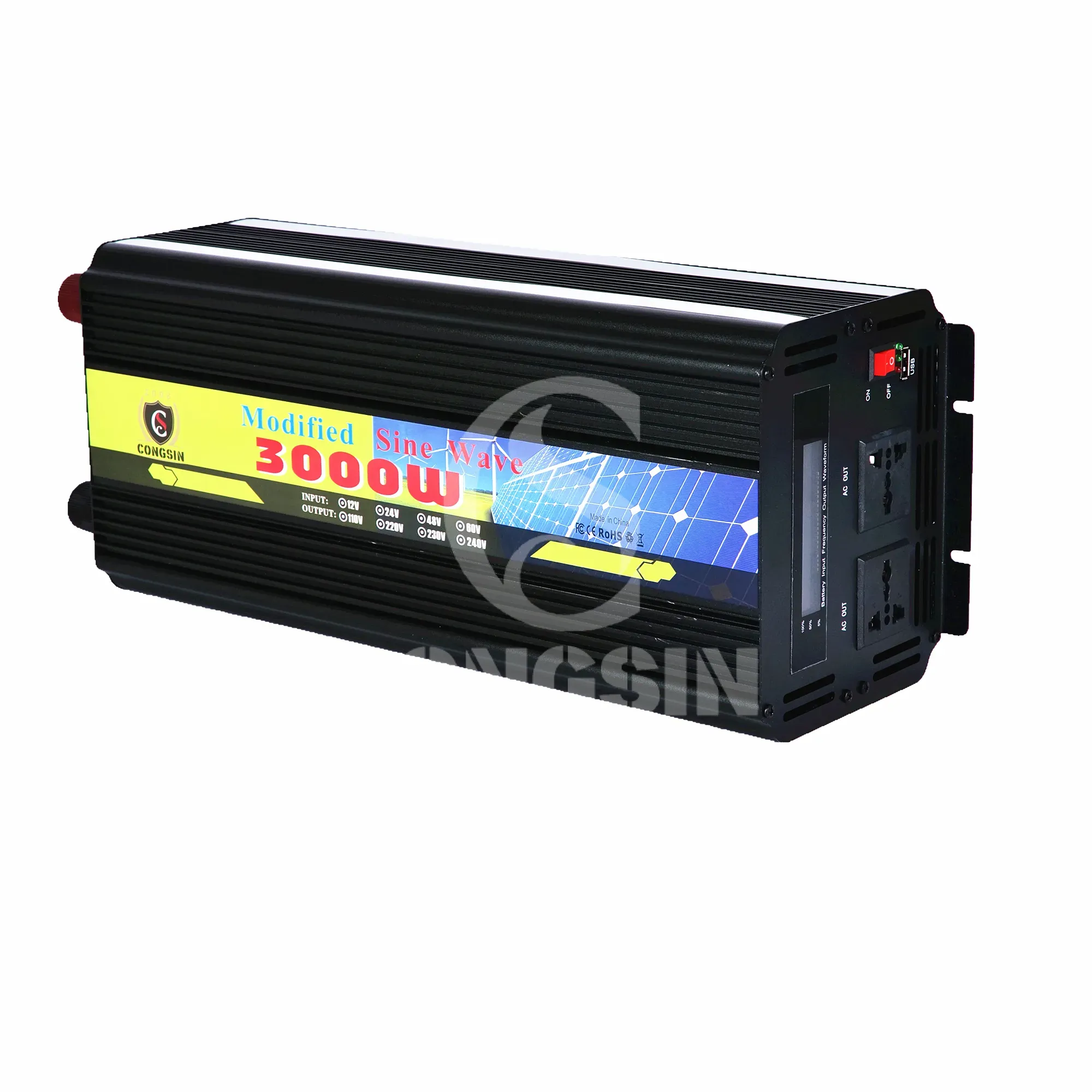
Congsin Full Power 3000W Modified Sine Wave Inverter Peak Power 6000W with LCD Display RV Solar
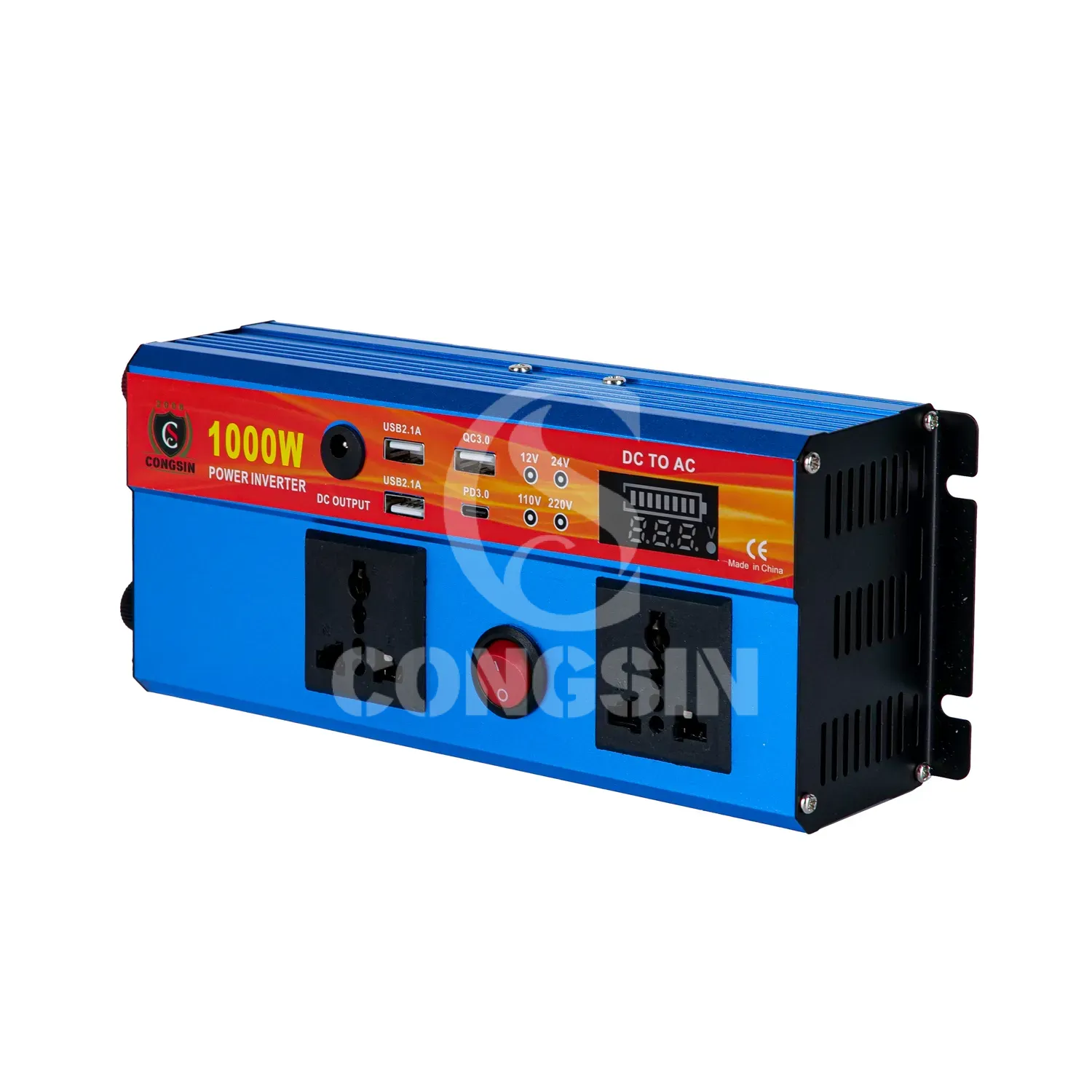
Congsin 1000W modified sine wave inverter with LED display and Type C port car RV power inverter
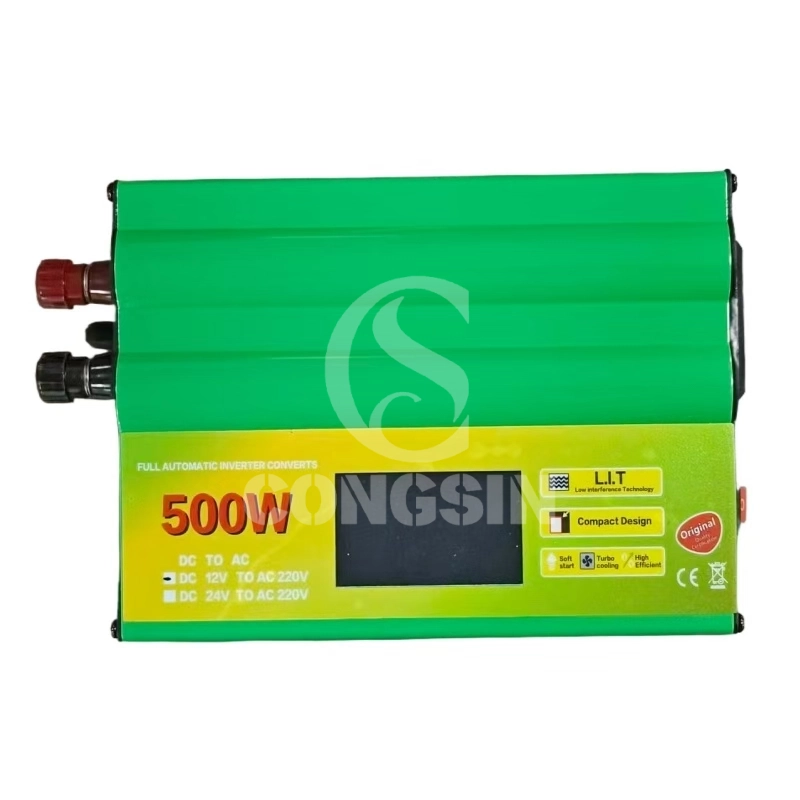
Congsin Modified Sine Wave Inverter 500W 1000W 1500W 12V LED Display Portable for RV Car Solar

CONGSIN is a trusted OEM factory for power inverters, solar charge controllers, and DC converters. Reliable solutions for global B2B buyers.
 High Quality
 7/24 Service
 Guaranteed Warranty
© 2025 Congsin. All Rights Reserved.